A Kiwi couple's cruising adventures on America's Great Loop and around the coast of New Zealand

Tuesday, 25 February 2014

What we done on our holiday #3

Thanks for the comments of encouragement - its good to know somebody does read it. Also forgive some of the strange skies in the pix. My camera has developed a black triangular blob near its top RH corner, so I am using MS Paint to rid of it and sometimes the end result is less than perfect.

Also I said in the last posting that the Bay was quite small and I wouldn't put any tracks on, but I have decided to put up a map with our most common track, to give you an idea of scale. The two magenta lines between Omakiwi Cove (OKC) and  Doves Bay,  and OKC and Opua, are about 10NM each.

Anyway, in the last episode we had just anchored in Omakiwi Cove, with the remnants of Cyclone June bearing down upon us. The first day was forecast for winds 35-45 knots from the E, for which OKC was well protected, with a change the following day to SW 50, gusting 65, to which it is not. Sure enough, by 11am the winds were honking through the trees at us and all the boats in the bay were swinging violently around on their anchors. We were anchored in 2 metres (7ft) of water at low tide and had 20 metres (66ft) of all chain rode out which made for the chain to be at a low angle away from the boat. As usual we had deployed a "snubber" line, which is a piece of rope that attaches to the anchor chain by means of a metal hook, and to the boat by means of a spliced loop around a cleat. The snubber is there to provide a shock absorber between the anchor and the boat and to take the strain off the windlass. It is good practice to have a piece of plastic hose slipped over the rope to prevent it chaffing against the boat. Now.... this is where Mr Silverton was REALLY remiss in designing the anchoring system on the 453. The bowsprit on the boat, through which the anchor and chain descend, is very thick and has sharp edges to the fibreglass. In shallow water, the angle of the rode is such that when the boat pulls up on the anchor after a strong wind gust, the snubber rubs against the sharp inside edge of the bowsprit, and the loose chain can get caught between the snubber and the fibreglass. The result in our case was, that after several hours of this, the plastic hose on the snubber had worn right through and the chain had gouged holes in the side of the bowsprit leaving sharp fibreglass edges that would soon sever the rope of the snubber itself. If it couldn't cope with 35-45 knots then it would certainly not withstand the 50-65 forecast for the next day, so an alternative had to be found. I got one of my spare braid docking lines and made a bowline loop for the end that wasn't already looped. In the middle I tied a "Burnham Bowline", which is an excellent knot for tying down loads and is often referred to as the "Trucker's knot". It is designed to provide a loop in the middle of a line, and will readily untie when you have finished with it, no matter how much load is applied to it during use. I then attached the hook to this knot using the original snubber rope, which was spliced to the hook. Unfortunately, I didn't have any plastic hose to put over the dock line, but hoped that it would be OK as a temporary fix anyway. The two ends of this "bridle" were looped over the dock mooring cleats either side of the bow and I dropped the hook over the front of the bowsprit, using a line with a dog-leash type clip attached to pull the hook back inside the bowsprit so I could attach it to the anchor chain. Once deployed it was clear of deficiencies of the single snubber and provided  the extra benefit of having 2 securing positions on the boat..

About this time the wind dropped and I sensed it was the "calm before the storm", and probably signalled the wind change. The next bay round, Waipiro Bay, is considered to be the best in the area for shelter from W winds so we decided to reposition there, as did most of the other boats in OKC. Waipiro Bay is quite popular and there are a lot of local moorings, so it was also important to get a good anchorage before the stuff hit the fan and the bay became too crowded. The wind did pick up again, but remained from the E. However, we decided to stay where we were for the above reasons and because it would be a good test of the new snubber bridle. By the time we went to bed that night I was confident that the anchor was holding well and the snubber was doing its job. At 3.00am the following morning I awoke with an uneasy feeling. The wind was howling and the boat was swinging, so I got up to check that everything was OK. The anchor was still holding and the snubber was fine, but there has been a slight change in wind direction that now had us swinging to within about 2 metres of an empty mooring buoy which, under the upcoming circumstances, I did not want wrapped around my shafts or rudders. So I sat up for 2 hours and watched us swing towards and away from the buoy, never getting closer than the 2 metres and at  5am I returned to bed. By 7am the wind had dropped and was beginning to turn, but I noticed we were hanging differently to the other boats around us. Also, when  I went topside, I could not see the buoy that I had watched for 2 hours earlier. Uh oh! its gotta be under the boat! A sudden gust of wind swung the boat to one side producing a scraping and bubbling noise, and suddenly the buoy bobbed to the surface right alongside covered in antifoul and looking a little worse for wear, but now clear of us!!! Time to go. We went a little further down the bay and re-anchored in slightly deeper water and well clear of any moorings. There was a little bit of chaffing on one side of the bridle where it had been rubbing against a protruding screw head, so I split a piece of the old snubber's hose and put it over the chafe and cable-tied it on and used the old snubber rope from the hook back to the docking cleat on that side as an extra safety precaution.
Calm before the storm
A couple of hours later, the wind arrived/ It was quite weird - the sun was shining, it was warm...but man,was it blowing!! I have been out in many gusty storms, but this one was particularly strange. Normally you will get an elevated wind gust that hits the boat, pulling it hard up on the anchor, but almost immediately drops back to the constant speed of the wind and the boat "relaxes" back on the anchor rode. These gusts were different - you could hear them coming as a roar across the bay, they would hit the boat and pull it up on the anchor, but then remain at gust speed for 3 or 4 minutes. This puts enormous forces on the anchor (and snubber), and both the boat in front of us and the one behind us succumbed and began to drag their anchors after one particularly harsh gust (a yachtie I met later told me that he was recording gusts in excess of 100 knots that day in Waipiro Bay). Fortunately both managed to relocate without incident and Loopy Kiwi (bless her little cottonsocks) remained perefctly fixed to the seabed for the duration.
Pictures never really give a good idea of wave height, but you can see from the above that we were in a well sheltered bay, yet those waves were reaching over a metre in height at times. (excuse the black blobs - I promise I'll get a new camera soon!). By 3.00pm the wind had "eased" back to 25 gusting 30 and by evening it had dropped to a gentle breeze. A much better night's sleep was had by all.

The next day was a lot calmer so we went across to Urupukapuka Bay (after a bit of a struggle to get the anchor up) where I reviewed the performance of the temporary snubber bridle. The side that had chaffed was quite bad, so I decided to retire it and made up a new temporary one from a conventional 3 strand dock line that I had aboard. This type of rope is much less susceptible to chaffing than braid and is easily spliced, and was actually a thicker line than the old one. Later that day there was a wind change and, amazingly, we dragged our anchor. When we pulled it up, we found it was covered in long seagrass and found out later that Urupuk Bay is notorious for dragging because of it. I didn't feel too bad later when I heard that a 40' sailing catamaran dragged his 35kg (77lb) anchor in the same bay - and that as the only time we dragged in the entire holiday.

After Urupuk, we spent a night in TeUenga Bay, the next one round from Waipiro, then cruised the 10NM or so to Opua marina to pick up Charlie and Pauline again for a couple of days. They live in Kerikeri on the West side of the bay and seldom get to see the East side, which is generally considered to be the prettier and more sheltered side. While we picked them up, we made a booking at the Opua marina for a couple of days out, so we could reprovision and recharge, as well as make up a permanent snubber for future adventures with the wind. We spent a couple of nice days at OKC before returning to Opua marina, and on the way there we ran into a pod of dolphins off Tapeka Point, just N of Russell.

Next episode.....more wind, more guests and further North we go

Monday, 24 February 2014

What we done on our holiday #2

Marsden Cove is approximately half way to the Bay of Islands (usually referred to as just "The Bay"). We decided to continue the journey as before, with Charlie and I (and Woody) taking the boat North, while the girls continued by road. While it was possible to do the remainder in one day, it was a long way over open sea and the weather was not looking that good, so we reckoned on doing an overnight stopover halfway up the coast. From 10NM north of Kawau, around Cape Rodney all the way across Bream Bay to Marsden Cove, there are no sheltered anchorages so the trip has to be done in one hit. Further North, however, there are good sheltered harbours every 20NM or so, which is just as well because that coast is even more exposed to winds and swell than that to the south.

In keeping with the norm, the wind was forecast as 15-20 knot Southerly with a 2 metre SE swell, which was mainly on the stern after we had battled for the first hour in the big beam sea to get around the Whangarei Heads. We continued past Tutukaka Harbour as it was too soon to stop, but by the time we reached Whangaruru Harbour, we had been going for 4 hours and had had enough of the rock n roll. Whangaruru is a long harbour with plenty of small bays that can provide shelter from winds from any direction. We chose one on the N headland called Teparapara Bay and spent a calm night at anchor with another couple of launches. Later in the evening, a bunch of Game fishing boats cruised further up harbour and anchored for the night.

The next day turned out calm and clear, so we got underway early to head for the Bay. As we left, we joined the flotilla of game boats that were heading out for the day looking for Marlin. Most of them had come down from the Bay and obviously spend the night at Whangaruru so they can be close to the fishing grounds the next day. The trip was significantly different from the day before, with a gentle rolling swell and light wind. We rounded Cape Brett late morning and were in the Bay before lunchtime.
Cape Brett and Piercy Island, which has the famous "hole in the rock", that they drive big sightseeing boats through

Cape Brett lighthouse
We anchored in a small bay on one of the islands for lunch and then crossed to the Northern part of the Bay to the Kerikeri inlet and Doves Bay Marina, to pick up the Admiral and drop Charlie off. The Bay is quite a small area and has hundreds of islands (hence the name). Like Auckland's outer harbour/inner Gulf, it is a wonderful cruising ground with deep water anchorages that can provide shelter somewhere from winds from any direction - which turned out to be just as well as time progressed.

I will not put any tracks on the map of the Bay for the time we were there or it will get so criss-crossed with lines that you won't be able to see the detail, but I have put the names of the bays that we anchored in overnight. The first  night was spent in Omakiwi Cove, which is one of our favourites with a secluded sandy beach, sheltered from all winds except due West. This was a good choice as the weather was due to deteriorate as the remains of Cyclone June descended from the Tropics towards us, and we experienced our next issue with the anchoring system..........

But that's another story and you will have to wait for the next episode to hear about it.

TTFN

Sunday, 23 February 2014

What we done on our holiday #1

I finally managed to get blogger to upload pix, by changing browsers.

The first stint was a 35NM cruise up to Kawau island, and we did this in perfect calm conditions, passing our new home in Orewa along the way. We met up with some of our Marina friends, who were returning from their holidays at Great Barrier Island, in Bon Accord Harbour - one of the most sheltered harbours in the Hauraki Gulf. Which is just as well as it began to blow the following day and this became a trend for the rest of our holiday.
The AGLCA Burgee flies in Bon Accord harbour, New Zealand

In the harbour is Mansion House Bay which contains the property once owned by Sir George Grey, Governor General of New Zealand in 1862 (he actually owned the whole island). Check out: http://www.doc.govt.nz/conservation/historic/by-region/auckland/hauraki-gulf-islands/kawau-island-historic-reserve/mansion-house/. Once it was a pub with associated motel units, and apparently the sea floor was so littered with beer bottles that it was hard to get an anchor to hold. Its now a DOC park, the motel units and the beer bottles are gone and the mansion restored. We visited it with our friends from Westpark, although I had to remain aboard and look after Woody as dogs are not permitted on DOC territory.
The next day we had arranged to pick up Charlie and Pauline from the mainland at Sandspit wharf, about 6 NM from Bon Accord and, while waiting for them to arrive, we had our first issue with the anchoring system. I have said before that US boats are generally not designed for anchoring out, and tend to have substandard ground tackle. There is also not much thought given to the design of the anchoring system and the Silverton 453 is particularly poor in this regard. The bow roller, which is way undersized, has a stainless steel strap "loop" over it to stop the anchor rode (chain in our case) falling off the roller. It is held to the roller bracket by the same bolt and nut that secures the roller. Because of this, it tends to flop backwards and forwards as the anchor is released or retrieved, and jams the chain against the bracket. If you tighten it hard to prevent that happening, the roller won't turn, but I had opted for this compromise rather that continually having to manually push the strap back into position. Before leaving I had fitted an additional bow roller and bracket behind the original one which helped hold the chain in position at anchor and prevented it from rubbing against the stainless plate in front of the windlass and thus removing all the galvanising from the chain.

While waiting for Charlie and Pauline, the wind had risen to a blustery 35 knots with gusts to 45, and we were subjected to being pulled up hard on the anchor for several hours. By the time it came for us to leave, the anchor had dug in well (which is a good thing) but as I pulled the anchor up, I found that the movement of the strap had loosened the bolt though the roller and the nut had fallen off. We were in a narrow river amongst moored craft, with a strong current and a gusty wind, so I had no choice but to continue raising the anchor. As I did, the bolt wound itself out of one side of its bracket and was now holding the roller on one side only (the bolt cannot come right out due to its position in the bowsprit of the boat). By now the chain was pointing straight down on the skewed roller and the anchor was firmly stuck in the mud. The usual procedure in this instance is to gently drive the boat forward to break the anchor out and this proved to be successful in this case. However, the force necessary to clear the anchor was too much for the bracket holding only one side of the bolt through the roller. By the time we got the anchor stowed, the bracket (which is 6mm stainless steel) was bent at about a 30 degree angle and the stainless strap was twisted entirely out of its usual loop shape. We tied up to Sandspit wharf and got our guests aboard realising we could not go anywhere until the problem was resolved, as we could not use the anchor as it was. Fortunately, we had a spare nut but the bracket was now so bent that the bolt would no longer go right through to the other side of the bracket. But "labor omnia vincit" (perserverance overcomes everything), and after an hour or so of blood, sweat and cussing, Charlie and I managed to bend the bracket far enough to get 2 threads of the bolt through the other side, and fit the nut. We were then able to tighten the nut, which in turn jacked the side of the bracket closer to its normal position. We also managed to bend the strap back into the semblance of a loop and we were good to go, although it was a very bouncy trip back to Bon Accord

We stayed in Bon Accord another 2 days, visiting Mansion House again with Charlie and Pauline, and then Charlie and I (and Woody) departed North in the boat after dropping the girls back at Sandspit. They would take the car and rendezvous with us at Marsden Cove Marina, near the Whangarei Heads and because they planned on a typical girls day out (shopping etc), we expected we would probably arrive first, despite it being a four and a half hour sea voyage, as opposed to a 1 hour drive. The voyage takes you across Bream Bay, and you run along a coastline that is quite like that of Lake Michigan, except the hills behind the sand dunes are a lot higher than those around Wisconsin and Michigan, and the other side of our "lake" is 5000NM away in Concepcion, Chile, with nothing in between. Like Michigan, there is a lot of reach for wind to kick the sea up, and we had a 25 knot SE on our stern quarter blowing over a 1.5 - 2 metre swell. This resulted in waves around 1.5 - 2.5 metres (5-7ft) and a pretty uncomfortable ride, although the boat handled it well.

As anticipated, we arrived at Marsden Cove before the girls and even changed berths to one more convenient before they turned up. Marsden Cove is a relatively new marina and is associated with a housing development that became stalled during the recession. There is not a lot of infrastructure or trees around and it is built on a flat plain between some high hills and the sea. As a result, it is fairly exposed to winds from most directions and getting onto the berths proved difficult. Still it is reasonably priced with good facilities and a fine restaurant.

We stayed 2 days and used the opportunity to reprovision, charge the batteries and refill with water. During our housemove, I found I had a residential water meter that had never been used. Originally I planned to sell it on TradeMe and then as scrap, but it wasn't worth much so I decided to keep it on the boat for measuring how much water we use when we are at sea. It turns about to be quite useful as now we know how long our tank water will last. It turns out that we use around 22-25 litres per day per person, so the 800 litres should last us 16 days with just the two of us, and proportionately less as we have guests. We used it over the entire holiday and the findings were pretty consistent throughout.

The next destination was the Bay of Islands, so I will leave that for another posting as this one has rambled on enough.


Thursday, 20 February 2014

Back again

Two months without a post may suggest we are not using Loopy Kiwi that much. In fact the opposite is true. In the 144 days since the beginning of October, I have been on the boat for 85 of them. Since New years day, we have travelled 590NM in her and put a further 84 hours on the engines, which is more than we did on the delivery voyage from Florida to Savannah. The lack of postings is probably more due to a feeling I have that maybe not too many folk are interested in the blog since the demise of our Loop adventure, but I stand to be corrected on that. Feel free to leave a comment.


We originally intended to cruise the Hauraki Gulf before Christmas and hang around until after the New Year, before heading North to the Bay of Islands. Many of our boating friends had left before then to cruise the Gulf, and it was our intention to join them, but a series of circumstances, and some pretty ordinary weather, prevented that from happening. Instead, we waited until after New Year and went out for a few days on Auckland's Minuscule Loop, returned to our Marina to provision, then headed North. Over the ensuing 5 weeks, we spent a lot of time in the Bay of Islands with our friends Charlie and Pauline and a few days with Auntie Lyn, went as far North as Whangaroa and "harbour-hopped" our way South to arrive back in Auckland last weekend. Rather than make this posting a "what we done on our holidays" saga, I will put details of individual points of interest in further postings over the next wee while, so it doesn't get too long winded or boring - because we did do some neat stuff and had some interesting experiences. And this is despite the fact that the weather was pretty appalling at times, being one of the windiest summers that I can recall in all my years of boating. However, it all went to prove that the Silverton 453 is a pretty seaworthy boat, and we learned a lot about Loopy Kiwi's performance and economy during the trip. We now know that our anchor will hold in winds gusting over 65 knots. and that the new method of "snubbing" the anchor chain (devised as a result of the old system failing) will remain secure in almost any conditions. We know now how long we have to run the genset each day if we want to stay at sea indefinitely, and most importantly, what our fuel consumption is at normal cruising speed. We also know that Woody is becoming a real sea dog and was rarely scared even in the worst sea conditions (although there is a tale coming up of "Woody and the Dolphins" that struck him with terror). Since many of the islands around New Zealand are now wildlife sanctuaries, we are pleased that we trained him to do his business aboard, and in fact he has settled on a part of the foredeck we have come to call the "poop deck", and he rarely goes ashore other than for recreational purposes.


I made up a map of our route, but for some reason Blogger doesn't want to load pix today, so I will leave that till the next post.

Sunday, 15 December 2013

More wee Jobs

New Zealander's have a passion for fishing. If you own a boat you are expected to fish out of it, and we have done so with all our boats for many, many years. So when we first looked for a Loop boat, we figured we would get one with a cockpit - so we could fish off it. As it turned out, and since we were never going to bring our Loop boat back to NZ (yeah, right), we settled on the cockpitless Silverton 453. Now, since the boat has made its way back here, the requirement for fishing has returned once again. While the 453 has no cockpit, it does come with a very large landing board (swim platform) on which you can fish, cook BBQ's, or hold a small square dance, if the fancy takes you. The dinghy stows across the back of it on Weaver davits and that provides for a secure area for outdoor activities as described above -  other than the stays that hold it upright which everyone who comes aboard smacks their heads against at least once!

However when the dinghy is in the water, there is a lot of open space on the landing board and nothing to hang on to when you are getting in and out of it. You also get the uneasy feeling when having a barby on the landing board with the  trusty Weber grill on its trolley, that at any moment the entire kit and caboodle will roll into the tide (not that it ever would - but I actually do tie the trolley to a hand rail, just in case). Another issue was that there were no fishing rod holders anywhere on the boat, and very few places to mount any. I was contemplating these situations the last time we had a barby on board (BOB) and it suddenly struck me that a handrail across the back of the landing board would overcome all of these problems and provide other benefits as well. Accordingly I began investigating having such a fitting made up. As it turned out, a local chap at our marina had a couple of stainless steel rails that he didn't want. They were originally from a supermarket (you know - from the place where the shopping carts are guided in to the store) and when I took one down to the boat, it not only was exactly what I was looking for, it even lined up with some of the existing bolt holes for other devices. Down to the local stainless steel fabricators it went (where it is known as a "staple") and extra rails and the rod holders were added. Over the weekend I took it down to Loopy Kiwi and fitted it, and this is how it turned out

 
So....it provides a nice secure back fence for activities on the landing board as well as somewhere to put the rods when fishing if you need to go elsewhere for a wee while. It doesn't interfere with the raising and lowering of the dinghy, or getting on and off the boat at the dock, and it provides something substantial to grab when climbing in and out of the dinghy at anchor. I hope it will also double as a hand grip for climbing up the swim ladder - if not I can always have a grab handle mounted to the side of it.
 
You may also note in a couple of the pix that the outboard motor is now stowed vertically on a transom mounted bracket. The previous owner had it on a bracket that lay it down on the landing board - which was real dumb because it took up a lot of space, was a trip hazard and was not particularly good for the motor.
Much easier to handle and stow now, and I made the lowest rail on the staple high enough for the outboard to slide underneath for fitting to the dinghy.
 
In the last posting I didn't put any pix up of the raw water alarm I had just fitted (because I didn't have any at the time). Well now I have so here they are


 That's all for now - till next time.


Wednesday, 4 December 2013

A few more mods.

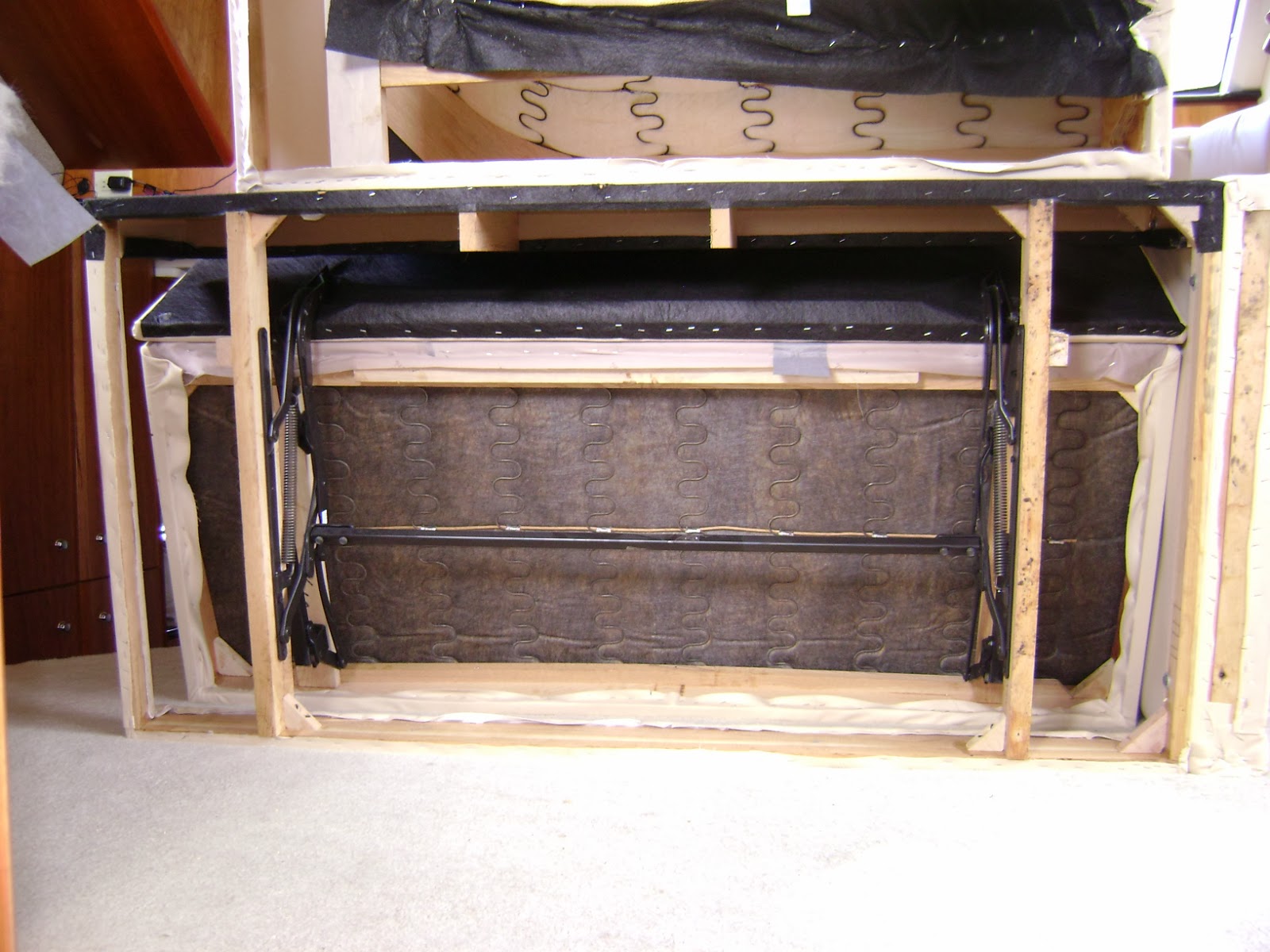
Loopy Kiwi came with a leather sofa in the saloon that folds out into a bed. Very comfortable, but low to the floor making it difficult for the Admiral to get up out of it with her arthritic knees. At home we had a similar problem which was overcome by screwing 100mm (4") feet to the bases of the sofas. Not so easy with a sofa in a boat, particularly when it turns into a bed - the problem being that there was no solid base and the runners that support the bed mechanism are 10mm (3/8") below the rest of the frame. However, the Admiral had requested that it be modified as her birthday present, so the project was duly commenced.
It was essential that it worked right but also that it looked right. so the answer was to build a box frame 90mm high that matched, and raised, the support runners. This was made of decking timber, which just happened to be exactly the right thickness (and was also the cheapest) 
I then used 10mm ply to pick up the rest of the framework and added fascias, screwed from the inside so there were no fastenings showing. These were made of our most common building timber Radiata Pine (Monterey Pine) and were stained with Cabot's "Crabwood" stain and varnish to  match the existing timber. 
The sofa has always been smaller that the gap that it fitted to, so the two sections of it used to pull apart after a bit of use, so I made up a packer that screwed to the wall to keep them together. this was also made of pine and stained to match.
The end result came out pretty good, even if I say so myself (but I'm kinda biased), and the Admiral was delighted with her birthday gift.
and here are the before and after pics

There is now even some storage underneath for bedding and for the little feet that the bed legs have to sit on when they are deployed

Another pet hate on the boat had been the galley table, which had been designed for anorexic people.
So while I was in "chainsaw" mode, I took to it and removed enough of it to make it usable, but not so much that it became useless. In doing so I also stripped it back to the bare timber and re-varnished it with clear varnish, believing that the timber was in its natural colour. It became obvious after the second coat that it had originally been stained to match the rest of the timberwork, but by then it was too late, and I did not feel like stripping all the new varnish off and starting again. As it turned out, the new lighter colour was a good match for the leather furniture and we have decided to leave it as it is.


I have already mentioned in previous posts that LK is fitted with underwater exhaust outlets. Not only are they horrible to paint, they also hide any evidence that the engines are pumping water and this has always been a considerable concern. A couple of months ago, I procured a "save your engines" kit from the USA, which consists of 2 flow sensors that fit to the raw water inlets to each engine, and a panel on the flybridge that lights up in the event of flow failure. See http://www.aqualarm.net/comerus/store/comersus_viewItem.asp?idProduct=3526.
 
The sensors were relatively easy to fit to the pipework between the raw water strainers and the engines, but it also requires wires to be run from the engine room to the flybridge - which was not quite so easy. Fortunately my good friend and fellow 453 owner, Bert, advised my the best route for the wiring. This included removing several fixings on the bridge and removal of a wall panel from the inside of the saloon. Even then getting the wire from one place to the other was a frustrating and time consuming job and I ended up running a spare cable of 8 wires through at the same time, just so I don't have to pull the interior apart again if I need more connections up there.
 
I also did a oil and filter change, so LK is now ready for the summer (although there is still plenty more to do - it is a boat after all!)
 
We've just spent a week up in the Bay of Islands helping Charlie and Pauline get their boat ready for summer as well, in payment for their help we had with Loopy Kiwi a few months ago. Mercifully, Charlie's boat is a bit smaller than LK and it is much less stressful carving bits out of someone else's boat than it is your own. We had very co-operative weather while we worked and it looks like we can expect a long hot summer. It will certainly be our intention to spend some of it up in the north in the continuation of our cruising lifestyle around New Zealand.

Tuesday, 5 November 2013

Aucklands Miniscule Loop

.... the antonym of America's Great Loop.

70 Nautical miles around the island of Waiheke in New Zealand's Hauraki Gulf in some of the prettiest and safest cruising grounds in the world. In anticipation of the upcoming Labour weekend, Lois had taken time off work and she and Lyn came down early, so we got underway on Wednesday in mediocre weather, but with a an improving forecast. One great thing about this "little loop" is that Waiheke and its surrounding islands, plus their proximity to the mainland, provide for shelter somewhere no matter what the wind direction or speed is. There are myriads of deep bays available for anchoring and 3 hours after departure from the marina we were in Chamberlins Bay on Ponui Island. Being early in the season and mid week, we found ourselves alone the first night - very reminiscent of some of our anchorages on the Great Loop , but for different reasons.
The building on the foreshore is a shearing shed, and we were entertained in the morning by braying donkeys as well as bleating sheep and barking dogs - very pastoral!

We decided to try our luck fishing that day (Thursday) and toodled round to Hook Bay which has usually been profitable in this regard. Although it is still very early in the season, we managed to land 7 snapper and a red cod to provide us with enough fish for dinner that evening.
We spent that evening in Man O War Bay, at the "bottom end" of Waiheke,  with only a couple of yachts (sailboats) for company - although more and more traffic was evident as the weekend loomed closer. The following day was Friday and the weather forecast was such that it was obvious that MOW Bay was going to be very popular for the weekend. Although it is relatively isolated, the Bay has a boutique winery and we decided to take a trip ashore and sample the fare before the rush.

By the time we returned to the boat, the early escapees from the real world started rolling in and by mid afternoon the Bay had about 20 boats in it. A number were anchored nearby to us, under the shelter of the cliffs on  the NW shore, from where the brisk wind was blowing. A short time later, we noticed that the nearby boats were pulling up their anchors and moving further down the  bay. When they had all gone, we figured it might be pertinent to listen to the weather forecast and, sure enough, Metservice were now forecasting  a SW change with winds averaging 15 and gusting 20 knots. Having been anchored there more than 24 hours, we were well dug in but as the wind turned, we swung round into shallower water and the rocky shore began to look rather close by. Discretion being the better part of cowardice, I decided to move further down the bay with the others and, by the time we got the engines started and the anchor up, a SW squall with gusts to 45kts made the move a very sensible decision. The squall lasted about half an hour, after which the weather calmed down again for a very peaceful night.

The boats started arriving from around 9am  and we decided it was time to go. There was a gentle SW breeze and this was forecast to continue for the rest of the weekend, so we continued our circumnavigation of Waiheke by cruising up the Northern side of the island. We anchored Saturday night in Onetangi Bay, where conditions were ideal to break out the Weber for  barbie on the swim platform.
There were about 20 boats in that bay that night, and the next day we continued around the island to the next one, our favourite anchorage, Oneroa. The township of Oneroa is the largest on the island and, with a large sandy beach sheltered from winds North through West to South, is a popular anchorage for boaties. We dinghied ashore to the township up the hill to replenish our dwindling wine stocks and returned to Loopy Kiwi for another evening Barbie and a singalong.
 
Labour day Monday was time to reluctantly go home, as some folk (Lois anyway) had to go to work the next day. The return was uneventful, but we did pass this interesting looking vessel anchored near the city docks.

She is the 119 metre (394ft) superyacht "A" owned by Russian Billionaire Andrey Melnichenko, and is worth around  US300 million. It is also described as the most loved and loathed ship on the sea and personally I agree with the latter - it is butt ugly!
 
Well, that's the Miniscule Auckland Loop. Not the size of its US counterpart, but a lot of fun and a heck of a lot easier to get to.
 Till next time