

Wednesday, 7 August 2013
Kindred Spirit in Levin
Just a pic sent by the new owner of KS trucking through Levin, 60km from her new home at Mana marina.


Sunday, 4 August 2013
Gone but not forgotten.
As I said in yesterday's post, Kindred Spirit sold (to Richard, in Wellington) and today we had our final cruise in her from berth (slip) G39 around to the travelift for haulout onto the transporter. It was an interesting start as the upstairs helm station had been knocked into gear when Richard and his mate removed the radar arch and flybridge covers last week. As a result KS lept forward as the engine started and tried to tow the pier away - maybe she didn't want to leave, or wanted to take part of Westpark with her. It was drizzling as we drove round, but the sky cleared as she was waterblasted (pressure washed) and became a beautiful day by the time she was loaded on to the trailer. Both the 3 year old antifoul and 2 year old propspeed were in remarkable condition and she still looked very pretty, despite the condition of her topsides which are now in dire need of a repaint. Apparently when she reaches Wellington, she will be driven across Cook Strait to Picton where she will be repainted and restored to her former glory - which she justly deserves.
Anyway here are some pix of her last journey in Auckland.


Anyway here are some pix of her last journey in Auckland.


Bottoms up
My humble apologies to followers for the lack of postings. I kinda thought that no-one really cared about the blog now that we aren't Looping any more, but I have received a few complaints about the lack of updates so I figured I had better make the effort. It has been a very busy time for us as we downsize from our large home to the apartment that we have bought in Orewa. Our house sold in 16 days but, fortunately, settlement isn't until mid September, so we thought we had plenty of time....but doesn't it just zoom by!!
When we first bought Loopy Kiwi in 2011, it was obvious she needed antifouling (bottom paint) and it was our intention to have this done when we reached Florida, and included coating the running gear with Propspeed. Because of the circumstances, nothing was done there and by the time we reached Savannah and had the hull waterblasted (pressure washed), a great deal of the bottom paint was missing and we were back to the gelcoat in many places. As there are several fiberglass boats in our Marina suffering from "rotten bottoms" caused by osmosis, it became imperative to me that the hull was repainted as soon as was practicable.
Originally, I intended that this would be as I was quoted to have the work done by the tradespeople in the USA..ie "a heavy sand and 2 coats of bottom paint" ($2300 BTW!!!), but it was noticeable that in many place that the bottom paint had fallen off, that there had never been any sealer or barrier applied to the gelcoat before the antifoul was painted on. You may get away with this in fresh water, but in the sea this practice (apparently) is and invitation to promote osmosis (blisters) and a humungous future problem. So I was advised that we should remove all of the existing bottom paint back to the gelcoat, sand with 80 grit sandpaper to a dull finish and apply 2 coats of 2 pot epoxy barrier primer, before overcoating with 2 coats of antifoul (bottom paint).
Sounds easy, eh! and while it wasn't particularly difficult, there were many times when I wondered what I was thinking to buy a boat with such a big bum. Charlie came down to give me a hand and, after we had removed all the old antifoul and we had to sand the bottom, we found that crouching beneath and pushing upward with the sander to be very strenuous. In the States I had observed that hardstand were generally concrete and the boats were propped up low to the ground and the guys doing the work would use mechanic's "garage creepers" (little flat trolleys that you lay down on) to sand and paint the hulls. Our boat was relatively high off the ground, which is gravel, so this was impossible to mimic. Overnight I had a revelation of an easier way and we tried it out the following day:
 It was very successful, and made the job a lot easier to achieve the result we wanted


When we first bought Loopy Kiwi in 2011, it was obvious she needed antifouling (bottom paint) and it was our intention to have this done when we reached Florida, and included coating the running gear with Propspeed. Because of the circumstances, nothing was done there and by the time we reached Savannah and had the hull waterblasted (pressure washed), a great deal of the bottom paint was missing and we were back to the gelcoat in many places. As there are several fiberglass boats in our Marina suffering from "rotten bottoms" caused by osmosis, it became imperative to me that the hull was repainted as soon as was practicable.
Originally, I intended that this would be as I was quoted to have the work done by the tradespeople in the USA..ie "a heavy sand and 2 coats of bottom paint" ($2300 BTW!!!), but it was noticeable that in many place that the bottom paint had fallen off, that there had never been any sealer or barrier applied to the gelcoat before the antifoul was painted on. You may get away with this in fresh water, but in the sea this practice (apparently) is and invitation to promote osmosis (blisters) and a humungous future problem. So I was advised that we should remove all of the existing bottom paint back to the gelcoat, sand with 80 grit sandpaper to a dull finish and apply 2 coats of 2 pot epoxy barrier primer, before overcoating with 2 coats of antifoul (bottom paint).
Sounds easy, eh! and while it wasn't particularly difficult, there were many times when I wondered what I was thinking to buy a boat with such a big bum. Charlie came down to give me a hand and, after we had removed all the old antifoul and we had to sand the bottom, we found that crouching beneath and pushing upward with the sander to be very strenuous. In the States I had observed that hardstand were generally concrete and the boats were propped up low to the ground and the guys doing the work would use mechanic's "garage creepers" (little flat trolleys that you lay down on) to sand and paint the hulls. Our boat was relatively high off the ground, which is gravel, so this was impossible to mimic. Overnight I had a revelation of an easier way and we tried it out the following day:


Loopy Kiwi is unusual in that she has underwater exhausts. They are fabricated from stainless steel and were coated with a black epoxy paint that had stuck perfectly well for the 8 years that the boat was in fresh water. However, once she reached the sea, all that changed and the paint began to peel in places. Note that I said "in places", because where it hadn't peeled it did NOT want to come off. The makers of these exhausts and whoever decided to put them on the boat were the subject of significant blasphemous utterances during the removal of this paint.

We then had to apply 2 coats of the epoxy barrier to the hull and, as the second one "tacked off" the antifoul had to be applied immediately to bond to it, so we had a team of four of us applying it. The job was done in several hours and she was ready to have the propspeed coating for the running gear and the lower halves of the underwater exhausts. This was done the following day and she was returned to the water looking very pristine.


In the meantime, Kindred Spirit (look back to the beginning of the blog) has also sold and tomorrow is being lifted out to be transported to her new home in Wellington. The new owner is in the chemical cleaning business and supplied me with a container of phosphoric acid to clean the rust stains off Loopy Kiwi that came from the containers during shipping. We made it up into a 50/50 mix with water, broomed it on....and watched the rust disappear!!!. 3 cupsful of acid in water did the entire boat and she is now looking loverly again.
Well, that's the update. I read the AGLCA digest every day to see where the Loopers are at the moment and still wish we could have been there. But it has been a very mild winter and we will be in our new home soon and looking forward to summer cruising around New Zealand's beautiful coastline.
Monday, 17 June 2013
Power to the people
Or Loopy Kiwi anyway!
If you've been reading earlier postings, you will know that in the pre-Loop days I did a lot of research into the power supply to Loopy Kiwi to make her behave more like a New Zealand based boat as far as travelling and anchoring out were concerned. This resulted in the installation of a 3kW inverter, which was enough to run some of the appliances without having to resort to using the genset - particularly refrigeration - but certainly not the whole shebang. When we made the decision to bring LK home, the biggest issue was always going to the supply of shore power to make things work. Now, for those technophobes reading, forgive me for some of the content of this posting as it can't help but contain stuff that you will find frightfully boring, but it may be useful to those who are contemplating bringing a US boat to New Zealand, or somewhere else that has a similar power system to us - Europe, for example.
In New Zealand, the typical AC (alternating current) shore power supply is 240 V (volts) 50 Hz (hertz) 16A(amps). In the US, there are a variety of differing supplies but the most common these days is 240/115V 60Hz 50A. So....contrary to popular belief in NZ, you will notice that the USA does, in fact, have 240V like we do. However that voltage is where all similarity stops, because their 240V is a strange 240V indeed. Ours is a 3 wire, single phase system and theirs is a 4 wire system comprising 2 "hot" wires (L1 and L2 - sometimes referred to as "two phase") a neutral (L0) and an earth. Here is a drawing of the two differing systems:
 Our system provides 240V between the phase and neutral wires. The US system provides 115V between either "hot" wire and the neutral (L0), and 240V between both "hot wires". This is how you can have a boat with both 240V for the airconditioning and 115V for other appliances - as Loopy Kiwi does. One important point, though, is that the two hot wires must have waveforms that are 180 degrees apart from one another, or it just doesn't work. This is why you have to be careful when connecting a 240V 50A boat to 2 x 115V 30A supplies using a Y adapter as, if they are from the same source, you don't get 240V. You may recall earlier posts where I talked about a "smart Y" adapter that I had purchased (and later sold). They are designed to make sure the hot wires are out of phase to protect the 240V equipment on the boat.
The next problem is just the electrical appetite of US boats. Loopy Kiwi, in common with many American craft, is very hungry electrically as she expects to have 50A of supply in most situations. Even then, if all the appliances were turned on simultaneously, there would be enough load to exceed this limit by some considerable margin (not that anybody ever turns everything on at once!). So here we are now faced with trying to make everything go on a measly 16A supply which, according to the laws of Physics, can't be done. What we end up with, is the ability to have roughly 3.6kW of energy, which is not a lot more than we get from the inverter. We have achieved this by installing 2 x 2kW, 240V to 115V transformers (these were off the shelf items and were cheaper than having 1 x 3.6kW one specially made). They are also wound in such a way that we get the "out of phase" hot wires necessary to give us 240V for LK's aircon - not that we will be using it much as each unit draws around 7A. Ultimately I will change the electric hotplate to gas as it, alone, uses 15A when all 3 are on (and I hate how slow electric cooking is compared with gas!).
The final issue is the difference in frequency - NZ's 50Hz vs USA's 60Hz. This does not effect things like heating elements in water heaters or ovens, but will make motors, such as those in refrigerators run slower and hotter. Prior to my retirement, my Company was involved in importing specialised fans from the USA and in the 20 years of doing so we had no problems with running them on NZ frequencies using transformers. Since we modified LK, all the appliances that contain electric motors seem to be running fine.
Loopy Kiwi came to us fitted with a "Cablemaster" deployment and storage system for the 2 x 50A shore power cables (did I mention that LK actually has TWO of these 50A supplies - although the second was dedicated entirely to the aircon for the sundeck and flybridge, and we never used that). These even had remote controls so you could easily deploy or retrieve the bulky cables with one person, usually with much envy from fellow boaters. When I told the Admiral that we were removing them she was bitterly disappointed, but they had no further purpose and took up a lot of space behind the headboard of the master stateroom, making access to some of the serviceable items quite difficult to impossible. Here's a few before, during and after pix, so you'll see what I mean:


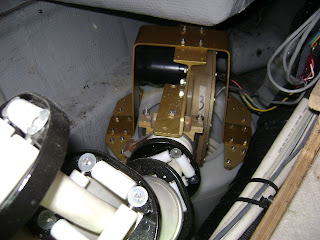
These are shots looking up to where the vacuflush unit for the aft head is located. How you would have got to it before the Cablemasters were removed is anybody's guess!
 The old power cords were 55ft long, around 1" in diameter and contained 4 cables, each with wire 16mm2 in cross sectional diameter. They have been replaced by a single cord about 3/8" in diameter and containing 3 wires each with a cross sectional diameter of 2.5mm2 each, Some difference!!!

 And here's everything that came out - anyone want to buy a couple of Cablemasters c/w 55ft 50A cables??
 We have made allowance for the 240V 50Hz system to be extended to the rest of the boat, particularly to replace 115V appliances if or when they fail. Fortunately, Silverton had the sense to build their boats with cabling suitable to run 240V appliances - probably because they had a reasonable export market to countries where 240V is the norm - which is not always the case in some US manufactured boats.
The next project is a liftout, bottom paint and Propspeed. We will probably give her a bit of a clean and polish at the same time to remove the rust stains etc from the shipment to NZ. The weather is pretty dismal here right now for doing this kind of work - hopefully it will improve in the next few weeks
If you've been reading earlier postings, you will know that in the pre-Loop days I did a lot of research into the power supply to Loopy Kiwi to make her behave more like a New Zealand based boat as far as travelling and anchoring out were concerned. This resulted in the installation of a 3kW inverter, which was enough to run some of the appliances without having to resort to using the genset - particularly refrigeration - but certainly not the whole shebang. When we made the decision to bring LK home, the biggest issue was always going to the supply of shore power to make things work. Now, for those technophobes reading, forgive me for some of the content of this posting as it can't help but contain stuff that you will find frightfully boring, but it may be useful to those who are contemplating bringing a US boat to New Zealand, or somewhere else that has a similar power system to us - Europe, for example.
In New Zealand, the typical AC (alternating current) shore power supply is 240 V (volts) 50 Hz (hertz) 16A(amps). In the US, there are a variety of differing supplies but the most common these days is 240/115V 60Hz 50A. So....contrary to popular belief in NZ, you will notice that the USA does, in fact, have 240V like we do. However that voltage is where all similarity stops, because their 240V is a strange 240V indeed. Ours is a 3 wire, single phase system and theirs is a 4 wire system comprising 2 "hot" wires (L1 and L2 - sometimes referred to as "two phase") a neutral (L0) and an earth. Here is a drawing of the two differing systems:

The next problem is just the electrical appetite of US boats. Loopy Kiwi, in common with many American craft, is very hungry electrically as she expects to have 50A of supply in most situations. Even then, if all the appliances were turned on simultaneously, there would be enough load to exceed this limit by some considerable margin (not that anybody ever turns everything on at once!). So here we are now faced with trying to make everything go on a measly 16A supply which, according to the laws of Physics, can't be done. What we end up with, is the ability to have roughly 3.6kW of energy, which is not a lot more than we get from the inverter. We have achieved this by installing 2 x 2kW, 240V to 115V transformers (these were off the shelf items and were cheaper than having 1 x 3.6kW one specially made). They are also wound in such a way that we get the "out of phase" hot wires necessary to give us 240V for LK's aircon - not that we will be using it much as each unit draws around 7A. Ultimately I will change the electric hotplate to gas as it, alone, uses 15A when all 3 are on (and I hate how slow electric cooking is compared with gas!).
The final issue is the difference in frequency - NZ's 50Hz vs USA's 60Hz. This does not effect things like heating elements in water heaters or ovens, but will make motors, such as those in refrigerators run slower and hotter. Prior to my retirement, my Company was involved in importing specialised fans from the USA and in the 20 years of doing so we had no problems with running them on NZ frequencies using transformers. Since we modified LK, all the appliances that contain electric motors seem to be running fine.
Loopy Kiwi came to us fitted with a "Cablemaster" deployment and storage system for the 2 x 50A shore power cables (did I mention that LK actually has TWO of these 50A supplies - although the second was dedicated entirely to the aircon for the sundeck and flybridge, and we never used that). These even had remote controls so you could easily deploy or retrieve the bulky cables with one person, usually with much envy from fellow boaters. When I told the Admiral that we were removing them she was bitterly disappointed, but they had no further purpose and took up a lot of space behind the headboard of the master stateroom, making access to some of the serviceable items quite difficult to impossible. Here's a few before, during and after pix, so you'll see what I mean:


These are shots looking up to where the vacuflush unit for the aft head is located. How you would have got to it before the Cablemasters were removed is anybody's guess!


The next project is a liftout, bottom paint and Propspeed. We will probably give her a bit of a clean and polish at the same time to remove the rust stains etc from the shipment to NZ. The weather is pretty dismal here right now for doing this kind of work - hopefully it will improve in the next few weeks
Friday, 7 June 2013
And off we go
Charlie arrived back with the girls (and Woody) at around 10.30 on a day that was one out of the bag. The morning had been so cold that I had fired up the genset to run the heating aboard for half an hour before I got out of bed! (No shore power here yet, you see - that issue is being addressed and is another story in itself), but it turned out to be one of those superb, still, winter days. The forecast was for this to continue for the next 3 days - just the time we needed to head up the coast to Auckland, 150 nautical miles away. It was too late to leave that day, so we did some more provisioning while we had Charlie and his ute available, and hunkered down at the marina for the night after he departed. We considered visiting Phil's Place for dinner, but decided to eat aboard Loopy Kiwi instead - for nostalgic reasons as much as anything else.
The next morning dawned fine and clear, but not as cold. We unhurriedly prepped to depart and finally got underway at around 10.30. The weather was clear and the seas calm as we left the harbour and headed towards Whitianga, around 70 NM up the coast.
 It was soooo good to be able to set the autopilot to a target 40 miles away knowing that you would neither run aground or run into some obstacle. The trip was mainly uneventful, with only a small stretch of uncomfortable beam sea for about an hour. However I did realise as we passed Slipper Island at about 2pm that I had not paid enough attention to the maths involved in that days travel, and that at our normal cruising speed, we would be struggling to reach our destination before dark. This was reinforced at 5pm when the sun began to fall behind the Coromandel ranges and we still had a half an hour to reach Whitianga marina. There was no other choice than to open the throttles and make up for a little lost time but, when we did this, both engines occasionally dropped a few hundred revs briefly then recovered, I put this down to the fact that they had not had a decent "blowout" for some time. We arrived at the marina and tied up just as the darkness descended, then went ashore and dined at a local pub where we had a delightful meal and several beverages. We figured out that the last time we had been to Whitianga in a boat was 2005.
The next day was another cracker, and we decide that we would not travel so far today and head for Tryphena Harbour on Great Barrier Island to visit our son, Adam, who lives there. We got underway at 10am and figured it would be about a 3 hour trip. The forecast was good - SW winds 10 -15 knots - which would be a bit on the beam but nothing worrisome. Half an hour out, Pete's transmission dropped out, just like it did that first day out of Indiantown FL. (refer 24th March) The difference was that this time it kept recurring - 4 times in fact - and we weren't going to be on an inland waterway if it failed completely. So we anchored up and I got out the manual to see what could be done to remedy the situation. All the symptoms pointed to a fault in the connections of the electronic shift control, so I rang the local Volvo agent who confirmed that I should remove and clean the connections to the solenoids on the gearbox to see if that fixed the problem. There was also the facility to mechanically force the gearboxes into forward drive, if all else failed.
The connections were cleaned, the engines restarted, and we continued on our way on the undertaking that we would turn back if the fault recurred within an hour. As it turned out, it didn't - so we resumed our journey towards the Barrier. About halfway there, the wind picked up to around 15 knots, giving us a 3-5 foot beam seas. We rolled a bit, but it was good to test out Loopy Kiwi in typical New Zealand weather conditions, and we maintained our course on autopilot, despite the sometimes uncomfortable conditions. Even Woody, who normally hates the earth moving underneath him, showed little concern as we made our way north.
Then we reached the Colville Channel. This is the channel between Great Barrier Island and The mainland and is renowned for its treacherous waters. It is probably one of the meanest stretches of water around NZ, second only to Cook Strait, and conditions are described in the Akarana Yacht Club Cruising Guide (NZ's boating bible) thus: "The flood tide flows W and the ebb tide flows E through his passage, running at 2 to 3 knots springs and producing dangerous overfalls (ie surf) in winds above 12 knots". At the time we entered it, the wind was averaging 20 knots and gusting to 28, according to the weather station on Channel Island, in the middle of the Colville Channel. This place is a good sea test for any vessel and I have to say that I was impressed with Loopy Kiwi's performance. The beam sea was 3-5 feet, with the occasional 7, and very steep. We maintained our course on autopilot until 3 miles from the entrance to Tryphena, when I decided we would head a little further upwind to take the sea on the bow quarter, then turn for a following sea to take us into the bay. As we were heading out, my sister (Aunty Lyn) asked how LK performed in a big following sea. My response was " we will find out I a couple of minutes". As it turned out, she performed admirably, confirming what John Niemann, the sales broker, had assured us of at the time of purchase - that Silverton made a good sea boat. We anchored up in the calm of Tryphena beside the ferry wharf and spent a nice night entertaining Adam who had come down to join us.
The next day was a stunner. We departed Barrier for the "bottom end" of Waiheke Island - a very familiar stomping (and fishing) ground for us. As we passed Channel Island the weather station was telling us it was averaging 2 knots with a peak of 3 - somewhat different from yesterday!
 As we neared Waiheke we could see boats everywhere, typical of a long weekend particularly with a great weather forecast. We stopped for a fish at Hook bay and picked up a blue cod and two snapper - enough for a feed for dinner. We then continued up the outside of the island to Oneroa, one of our most favourite anchorages. There were about 50 boats anchored here overnight - quite a modest number for what is generally considered the last boating weekend of the season. In the height of summer, you can get several hundred jammed into the Bay.
 We spent a comfortable night and departed early for the last leg of our delivery voyage - only around 20NM. As we cruised into the harbour, I felt some regret that it was not the statue of liberty that I was so looking forward to cruising past, but the Skytower over the Casino isn't a bad substitute under the circumstances, and made me feel like Loopy Kiwi was finally home.
 We arrived at our marina and onto a prearranged berth (slip), as Kindred Spirit is still on our own. We were surrounded by our friends as we showed them over our treasured possession, and there was just the right amount of envy to make all the trials and tribulations involved in bringing her home worthwhile. The next few weeks will involve making her work on our greatly reduced, and very different, shore power supply - but that is all in hand. She will then be lifted out (again) to have her bottom painted and PropSpeed applied to the running gear.
We have sold our house and by the time summer comes around we will be in our new apartment and free from the burden of owning a larger property. Loopy Kiwi will be ready and raring to go as we venture around New Zealand with our own version of "Great Loop" cruising.
The next morning dawned fine and clear, but not as cold. We unhurriedly prepped to depart and finally got underway at around 10.30. The weather was clear and the seas calm as we left the harbour and headed towards Whitianga, around 70 NM up the coast.

The next day was another cracker, and we decide that we would not travel so far today and head for Tryphena Harbour on Great Barrier Island to visit our son, Adam, who lives there. We got underway at 10am and figured it would be about a 3 hour trip. The forecast was good - SW winds 10 -15 knots - which would be a bit on the beam but nothing worrisome. Half an hour out, Pete's transmission dropped out, just like it did that first day out of Indiantown FL. (refer 24th March) The difference was that this time it kept recurring - 4 times in fact - and we weren't going to be on an inland waterway if it failed completely. So we anchored up and I got out the manual to see what could be done to remedy the situation. All the symptoms pointed to a fault in the connections of the electronic shift control, so I rang the local Volvo agent who confirmed that I should remove and clean the connections to the solenoids on the gearbox to see if that fixed the problem. There was also the facility to mechanically force the gearboxes into forward drive, if all else failed.
The connections were cleaned, the engines restarted, and we continued on our way on the undertaking that we would turn back if the fault recurred within an hour. As it turned out, it didn't - so we resumed our journey towards the Barrier. About halfway there, the wind picked up to around 15 knots, giving us a 3-5 foot beam seas. We rolled a bit, but it was good to test out Loopy Kiwi in typical New Zealand weather conditions, and we maintained our course on autopilot, despite the sometimes uncomfortable conditions. Even Woody, who normally hates the earth moving underneath him, showed little concern as we made our way north.
Then we reached the Colville Channel. This is the channel between Great Barrier Island and The mainland and is renowned for its treacherous waters. It is probably one of the meanest stretches of water around NZ, second only to Cook Strait, and conditions are described in the Akarana Yacht Club Cruising Guide (NZ's boating bible) thus: "The flood tide flows W and the ebb tide flows E through his passage, running at 2 to 3 knots springs and producing dangerous overfalls (ie surf) in winds above 12 knots". At the time we entered it, the wind was averaging 20 knots and gusting to 28, according to the weather station on Channel Island, in the middle of the Colville Channel. This place is a good sea test for any vessel and I have to say that I was impressed with Loopy Kiwi's performance. The beam sea was 3-5 feet, with the occasional 7, and very steep. We maintained our course on autopilot until 3 miles from the entrance to Tryphena, when I decided we would head a little further upwind to take the sea on the bow quarter, then turn for a following sea to take us into the bay. As we were heading out, my sister (Aunty Lyn) asked how LK performed in a big following sea. My response was " we will find out I a couple of minutes". As it turned out, she performed admirably, confirming what John Niemann, the sales broker, had assured us of at the time of purchase - that Silverton made a good sea boat. We anchored up in the calm of Tryphena beside the ferry wharf and spent a nice night entertaining Adam who had come down to join us.
The next day was a stunner. We departed Barrier for the "bottom end" of Waiheke Island - a very familiar stomping (and fishing) ground for us. As we passed Channel Island the weather station was telling us it was averaging 2 knots with a peak of 3 - somewhat different from yesterday!


We have sold our house and by the time summer comes around we will be in our new apartment and free from the burden of owning a larger property. Loopy Kiwi will be ready and raring to go as we venture around New Zealand with our own version of "Great Loop" cruising.
Thursday, 6 June 2013
The Eagle has landed
The preparations for arrival of Loopy Kiwi in Tauranga turned out to be as tortuous and frustrating as those for the departure from Savannah. We paid the tax and duty so all was clear with Customs (although the officer looking after us had gone on holiday for a week so we had to start over with a new guy). We sent all the docs through to the Port and were informed that Customs had put the incorrect Port on their paperwork and MPI (Ministry of Primary Produce - the agriculture folk) had misnamed the ship on theirs. So it took another couple of days to sort that out! We liaised with the Port Authority via the shipping company and were told that the ship was due in at 2pm on Tuesday 28th May and it would be off-loaded onto the wharf pending MPI inspection before being craned into the water. Thus we would have plenty of time to reattach the batteries that we were required to disconnect in Savannah (all nine of them) as Loopy Kiwi was immobile without doing so. The shipping Co said they would arrange access for us to the wharf, so the Friday before our departing for Tauranga on Monday, everything was in order.
Yeah....right!
On Sunday we got an email from the shipping co telling us we had to go through an induction course to have access to the wharf. Fortunately this could be done online and after sitting the exam at the end of the course, Charlie and I received a certificate that now enables us to enter the wharf any time for the next 12 months. On Monday we drove to Tauranga and checked in with the Port Authority guys. The ship had now been scheduled to arrive at 10am and Loopy Kiwi was due to be unloaded at slack tide at 3pm - provided clearance had been granted by MPI. However, we were now informed that she would be craned off the ship and straight into the water!!! Furthermore, we would not be allowed to be aboard when she was lifted off, and there was no way to get aboard from the ship. They said we would have to organize a "chase boat" to transport us to LK after refloating, which we hurriedly did via the marina where we had arranged to spend our first night. We also restated that she was immobile until the batteries were reconnected and were told that the stevedores would hold us in the slings until this was done, and we could get underway under our own steam.
So there we were, with everything well under control, and only a couple of hour to wait before we would be reunited with our beloved Loopy Kiwi. Charlie and I headed down to the marina and checked in to ensure the necessary arrangements were in place for our ride to LK when she hit the water. We then took a drive to the entrance of the harbor and there, right on time, was the CMA CMG MANET entering the harbor, with LK in plain sight on the deck. Unfortunately my camera chose this moment to run out of batteries, so while you see the ship coming in, you don't see LK!
 We watched her till she docked, then called MPI who said they would meet us at the wharf in 30 minutes to do an inspection of the outside of the boat, and if that was OK, they would allow her to be refloated and do the interior at the marina the next day. We met him at the gate at the due time and he took us to the vessel and aboard for the inspection. To our disappointment, nobody checked our credentials that we had dutifully carried with us, including our much valued induction certificates that we had studied so hard for two days previous! The inspection passed without incident - we did notice that LK had shifted in her cradle and one of the upright supports had bent, but there seemed to be no damage. She now had clearance for the re-launch, so it was simply a matter of waiting for a few hours and we were ready to go. We did stress to the port authorities the importance of having the slings in the correct places as marked on the boat and were assured that all due care would be taken to ensure this happened. We retired to the marina, which was directly opposite the Port and watched as the containers were unloaded, waiting for a sign that LK was due to be lifted. As this had not happened at the prescribed time of 3pm we rang the Port and were told that we should come over when the container crane repositioned over LK from where it was presently operating. This happened at 3.45pm - so into the marina's RIB we got...and off we went. By the time we got alongside, LK was in plain view and, shortly after, they had begun to ready the slings to lift her off.

 From the water, everything looked fine, but as she came out it was obvious that the slings were far from being in the right places.


 You can probably figure out that it wasn't named after me, but what you may NOT know is that it is named after its owner, Phil Rudd, who happens to be the drummer from AC/DC!
The next day dawned beautiful. Loopy Kiwi was home, albeit covered in rust from the containers, soot from ships exhaust and grease from one of the cranes that a stevedore had managed to track right around the decks and across the carpet on the sundeck while securing the slings (in the wrong places). Still she had arrived intact...nothing broken or stolen, but I've got to say it felt strange having her over here instead of on the Loop. It was kind of weird to think that she had travelled almost 12000 nautical miles from Savannah, via Jamaica, the Panama Canal, Tahiti and even Australia since we had last spent a night on her. Charlie went home that day to bring Carolyn and Aunty Lyn down for the voyage to Auckland, our home Port. The weather forecast was looking very good for the long "Queens Birthday" weekend (not that we need long weekends to travel, us retired folk), and I will do a posting on that journey separately. In the meantime...take care y'all
Yeah....right!
On Sunday we got an email from the shipping co telling us we had to go through an induction course to have access to the wharf. Fortunately this could be done online and after sitting the exam at the end of the course, Charlie and I received a certificate that now enables us to enter the wharf any time for the next 12 months. On Monday we drove to Tauranga and checked in with the Port Authority guys. The ship had now been scheduled to arrive at 10am and Loopy Kiwi was due to be unloaded at slack tide at 3pm - provided clearance had been granted by MPI. However, we were now informed that she would be craned off the ship and straight into the water!!! Furthermore, we would not be allowed to be aboard when she was lifted off, and there was no way to get aboard from the ship. They said we would have to organize a "chase boat" to transport us to LK after refloating, which we hurriedly did via the marina where we had arranged to spend our first night. We also restated that she was immobile until the batteries were reconnected and were told that the stevedores would hold us in the slings until this was done, and we could get underway under our own steam.
So there we were, with everything well under control, and only a couple of hour to wait before we would be reunited with our beloved Loopy Kiwi. Charlie and I headed down to the marina and checked in to ensure the necessary arrangements were in place for our ride to LK when she hit the water. We then took a drive to the entrance of the harbor and there, right on time, was the CMA CMG MANET entering the harbor, with LK in plain sight on the deck. Unfortunately my camera chose this moment to run out of batteries, so while you see the ship coming in, you don't see LK!


But there she was...suspended a couple of hundred feet in the air and nothing could be done....so into the water she went. And she floated - so aboard we went and began to reconnect the batteries. Almost immediately, the stevedores (you know - those guys that were going to hold us in the slings until we got the engines going) began to whinge that they wanted to use the crane to unload containers. This is despite the fact that we had paid ten times the price of shipping a container from the USA to not be treated like one. Regardless of this, after 15 minutes, they lowered us completely into the water and basically let us go. Fortunately the marina RIB had hung around and he took us in tow around Tauranga harbour while we attached the rest of the batteries before firing up the engines (both started perfectly) and driving into the marina. BTW, by this time it was 5.15pm and, being winter in New Zealand, it was almost dark. After securing LK, we decided a celebration was in order and we dined in the restaurant at the marina, particularly since it was called "Phils Place"

The next day dawned beautiful. Loopy Kiwi was home, albeit covered in rust from the containers, soot from ships exhaust and grease from one of the cranes that a stevedore had managed to track right around the decks and across the carpet on the sundeck while securing the slings (in the wrong places). Still she had arrived intact...nothing broken or stolen, but I've got to say it felt strange having her over here instead of on the Loop. It was kind of weird to think that she had travelled almost 12000 nautical miles from Savannah, via Jamaica, the Panama Canal, Tahiti and even Australia since we had last spent a night on her. Charlie went home that day to bring Carolyn and Aunty Lyn down for the voyage to Auckland, our home Port. The weather forecast was looking very good for the long "Queens Birthday" weekend (not that we need long weekends to travel, us retired folk), and I will do a posting on that journey separately. In the meantime...take care y'all
 |
| Home is the sailor home from the sea |
Wednesday, 15 May 2013
Coming Home
The trip home reeked of (in the words of Mr Obama) "Deja Vue all over again". The United Airlines flight left Savannah 30 minutes late, due to the late arrival of the plane, but the pilot picked up the pace and we arrived on time in Chicago, giving us the full 1hr 20 to make our connection to LA. Not that this was necessary, as it turned out, because the attendants at the gate for the next flight began making announcements of a delay about 1 hour before we were due to board and this continued to be updated for the next 3 hours. The plane was showing as completely full when we arrived at the gate but, over the course of the delay, it began to empty out as people were forced to make alternative arrangements for connections in LA and by the time we boarded, there were about 20 empty seats. So we finally got aboard and waited while the baggage (presumably taken off to retrieve the bags for the people who had made other arrangements) was reloaded. This took around 45 minutes, but those of us right at the back of the plane did notice that 2 cartloads of cargo seemed to take most of that loading time! All set to go, when a young lady 2 rows in front of us decided she didn't want to go to LA any more (not on this plane, anyway) and insisted on getting off - which meant they had to find her bag as well, which took another 20 minutes or so. Finally we got underway and the captain graciously apologised and allowed us to have FREE access to the entertainment system for the 4.5hr flight. Whoopie-do!! So we arrived at 6.00pm, only 3hrs later than planned which, I guess, is a whole lot better than the 1.30am arrival that United subjected us to last time we flew with them to LA.
We had a relaxed days shopping in LA the next day and Air New Zealand departed on time that night for a comfortable 13hr crossing of the Pacific. It wasn't till we touched down in Auckland at 5.30am that the Captain informed us that he had been told to expect severe turbulence during the crossing - so we were pleased to have not been subjected to that!
While the change to our circumstances has had a considerable impact on our future boating adventures, this has only effected where we intend to cruise, and not necessarily how. As we are both now retired, we have plenty of time to take Loopy Kiwi where, and for as long as, we wish - so the plan has continued with regards to downsizing to a "lock up and leave" apartment to allow us to vacation on Loopy Kiwi when and where she may happen to be at the time. Prior to my departure for the USA to move the boat, we had looked for a suitable habitat and found one to our liking at Orewa Beach, 30 minutes north of our current home. It is an apartment presently under construction in a community style development and is expected to be ready for occupancy in September. We gave the developer the go-ahead 2 days after I arrived in the US and signed up 2 days after my return to NZ. In the meantime Carolyn had returned from her vacation on Great Barrier Island and began preparing our house for sale. Anyone who has ever downsized after 20 years to a place less than half the size will, no doubt, understand the chaos that we now find ourselves in. The house itself looks great, as it must for the prospective buyers.... but the garage....ugh! Still, we have a bit of time before the apartment is ready so we will just keep nibbling away at the pile of "stuff".
I went and saw New Zealand Customs last week to begin proceedings for Loopy Kiwi's entry into NZ. First we saw the Agricultural folk who, unsurprisingly, will want to undertake an inspection when she arrives in Tauranga. Interestingly, the things they are most concerned with are the bikes, the Barbecue and the vacuum cleaner as well as any food stored aboard - I suppose they are the more likely things to be carrying unwanted greebies into the country and I think we cleaned them all fairly thoroughly before loading Loopy Kiwi on to the ship (it WAS kinda hectic at the time, though). She is scheduled to arrive on May 28th and will be inspected and cleared on the wharf before re-launch is allowed. The Customs guys looked over the inventory and originally were interested in all the loose items (Barbecues, guitars, bikes etc) and wanted receipts for everything we had purchased in the USA for duty and tax calculation. Then they figured out what the duty and GST was going to be for the boat itself, and decided that the stuff aboard paled into insignificance when compared to that, so have waived that requirement. As we had owned the boat since October 2011, they allowed 8% depreciation on the original purchase price before calculating the 5% duty. The 15% GST, however, is calculated on the "total landed cost" which is the depreciated value PLUS the duty PLUS the freight and insurance, so it comes to a tidy sum. However, having spent 35 years in the importing business, we always knew that this was going to be the case. While they did look into some concession on medical grounds after hearing our saga, they have told us that there was nothing further they can do, and we will have to pay the duty and Tax before the boat is allowed to leave the wharf.
Well that's about all for now. Sorry there are no pix or maps this time, but there was nothing really to show. I'll plonk some on the next post of Loopy Kiwi's arrival in New Zealand and, hopefully, our trip up the coast to Auckland.
Till then............
We had a relaxed days shopping in LA the next day and Air New Zealand departed on time that night for a comfortable 13hr crossing of the Pacific. It wasn't till we touched down in Auckland at 5.30am that the Captain informed us that he had been told to expect severe turbulence during the crossing - so we were pleased to have not been subjected to that!
While the change to our circumstances has had a considerable impact on our future boating adventures, this has only effected where we intend to cruise, and not necessarily how. As we are both now retired, we have plenty of time to take Loopy Kiwi where, and for as long as, we wish - so the plan has continued with regards to downsizing to a "lock up and leave" apartment to allow us to vacation on Loopy Kiwi when and where she may happen to be at the time. Prior to my departure for the USA to move the boat, we had looked for a suitable habitat and found one to our liking at Orewa Beach, 30 minutes north of our current home. It is an apartment presently under construction in a community style development and is expected to be ready for occupancy in September. We gave the developer the go-ahead 2 days after I arrived in the US and signed up 2 days after my return to NZ. In the meantime Carolyn had returned from her vacation on Great Barrier Island and began preparing our house for sale. Anyone who has ever downsized after 20 years to a place less than half the size will, no doubt, understand the chaos that we now find ourselves in. The house itself looks great, as it must for the prospective buyers.... but the garage....ugh! Still, we have a bit of time before the apartment is ready so we will just keep nibbling away at the pile of "stuff".
I went and saw New Zealand Customs last week to begin proceedings for Loopy Kiwi's entry into NZ. First we saw the Agricultural folk who, unsurprisingly, will want to undertake an inspection when she arrives in Tauranga. Interestingly, the things they are most concerned with are the bikes, the Barbecue and the vacuum cleaner as well as any food stored aboard - I suppose they are the more likely things to be carrying unwanted greebies into the country and I think we cleaned them all fairly thoroughly before loading Loopy Kiwi on to the ship (it WAS kinda hectic at the time, though). She is scheduled to arrive on May 28th and will be inspected and cleared on the wharf before re-launch is allowed. The Customs guys looked over the inventory and originally were interested in all the loose items (Barbecues, guitars, bikes etc) and wanted receipts for everything we had purchased in the USA for duty and tax calculation. Then they figured out what the duty and GST was going to be for the boat itself, and decided that the stuff aboard paled into insignificance when compared to that, so have waived that requirement. As we had owned the boat since October 2011, they allowed 8% depreciation on the original purchase price before calculating the 5% duty. The 15% GST, however, is calculated on the "total landed cost" which is the depreciated value PLUS the duty PLUS the freight and insurance, so it comes to a tidy sum. However, having spent 35 years in the importing business, we always knew that this was going to be the case. While they did look into some concession on medical grounds after hearing our saga, they have told us that there was nothing further they can do, and we will have to pay the duty and Tax before the boat is allowed to leave the wharf.
Well that's about all for now. Sorry there are no pix or maps this time, but there was nothing really to show. I'll plonk some on the next post of Loopy Kiwi's arrival in New Zealand and, hopefully, our trip up the coast to Auckland.
Till then............
Subscribe to:
Posts (Atom)