A Kiwi couple's cruising adventures on America's Great Loop and around the coast of New Zealand

Monday, 27 July 2015

Noflex and venting

Since people often ask me, this is how Noflex works:

NOFLEX introduced into the system, being heavier than water, sinks to the bottom of the tank where anaerobic (dead bacteria sludge) concentrates. Upon contact it reacts with the sludge lifting it into the main stream releasing micro bubbles of oxygen that break up waste. This also releases the proteins out of the sludge that act as an additional source of nutrition for live bacteria. The oxygen and additional protein turn the unit into a super friendly medium for maximum growth capability.

NOFLEX is not a bacterial treatment enzyme biocide or perfumed product but a blend of chemicals that, when introduced into your sanitary system will very quickly neutralize hydrogen sulphides (unwanted odours), clean pipes and liquefy solids in your holding tank.

With the use of NOFLEX there is no need for carbon filters on vents or large quantities of product stowed in small cupboards. It is safe on plastics, cast iron and copper piping. As NOFLEX works into the tank it breaks down the organics in the wastewater, liquefying solids and greases to facilitate easy pump-outs. The spent residue from the reaction is sodium carbonate (baking soda) which helps buffer the solution for discharge to waste treatment facilities.


Raw Sewage


The bottle 1 hour after noflex has been added
1 hour after adding Noflex

the bottle 2 hours after the addition of noflex
2 hours after adding Noflex
One of the critical components of the process is that the holding tank is well ventilated, which is why the manufacturer recommends removal of vent filters which are prone to blocking. 

Since our Summer cruise (back to the Bay of Islands BTW) I have had a couple of strange happenings, one of which was the holding tank self filling with seawater by siphoning back through the macerator pump if I leave the seacock open (which I usually do). This can only happen if the discharge line that loops above the water line is full of effluent or water, and I usually ensure that the tank has completely discharged and is pumping air before I turn the pump off. And before you say "why don't you close the seacock after discharge", I always dump the tank while underway and to get to the seacock, I have to lean over the propeller shafts and couplings, which I don't like to do when they are spinning. This has been happening more often since our new year holiday, when the tank once overflowed through the vents.
The other happening was the return of a sewage smell in the master stateroom, particularly when the toilets were flushed, very reminiscent of the "pre Noflex" days. Over Easter I noticed there were rusty stains running from the vents down the side of the boat, so I cleaned them off, plus all the rust that had built up at the edges of the vent through-hull fittings. A couple of weeks later the smell was so bad in the boat that I figured there had to be something wrong, as I had been using more and more Noflex with little result. So I accessed the connections where the vent filters used to be (and noticed that there was a bit of crap inside the pipes), attached a garden hose and turned it on. For a start a mist of water came out the vent so, thinking it was clear (you can't actually see the vents themselves - they are hidden insider the through-hull fittings), I went and did the other side. Same result....a hissing mist but not a lot of water, so I presumed that's how it was supposed to be....I had never tried this before, so I didn't know what it was supposed to look like. I was about to disconnect the hose thinking the test hadn't really proved anything, when there was a "pop" from the vent and a short, yukkie brown discharge, followed by water gushing out. I then redid the other side leaving the water turned full on and after 5 minutes, sure enough, a pop, a brown discharge and pouring water. Obviously the vents had been partially blocked and may have been since we have owned the boat.....I know the vents had been flooded by the previous owner by the condition of the filters when I removed them.

So it looks like the blocked vents were causing the holding tank to pressurise during flushing and forcing effluent into the macerator discharge line, which allowed seawater to siphon back into the holding tank. It also meant that sewage gases could not vent overboard and were finding their way out through any means (probably the fittings where the filters used to be) into the bilge area of the boat and, ultimately, our stateroom.

In the 2 months since then, there has not been a hint of a smell in our stateroom, and the Admiral has commented that it is the first time the boat has been completely odour free since we have owned it.

Sunday, 7 December 2014

And the winner is... #2

Another post for which I had already used the title!

However there is a winner for the "Freddie" brain teaser.....and the prize goes to Chris.
FREDDIE
Yes, it is a Mercury, so Freddie is the obvious choice of name. For anyone still puzzled, Google Queen (the band) and see who their lead singer was.

Chris tells me  is also the proud owner of a Rickenbaker 12 string, the same model that was owned by George Harrison (who was the proud owner of the second one ever made!), and was first used by him in the Beatles hit "I call your name" and later in "a hard days night"

Chris' prize is a  holiday aboard Loopy Kiwi around the cruising grounds of the Hauraki Gulf. All he has to do is get to New Zealand to collect it, and bring his Rickenbaker with him so I can have a play with it!

Monday, 1 December 2014

The same, but different #2

In the absence of any postings on this blog to the contrary, I would have to forgive any readers (assuming I still have some) for thinking that Loopy Kiwi has been abandoned for the past 5 months over winter. However, again, it is quite the opposite and since the Admiral rediscovered her love of Bridge and attends the local club 3 or 4 times a week, I have been travelling down to our marina and staying aboard from Thursdays till Saturday or Sunday ....pottering about and tinkering with things as one does over winter. The Admiral often comes down after bridge on the Friday and will stay, particularly if there is a social event on nearby. Other than one trip out with our son and his family (which I will come to later) the stays are on the marina itself - the weather hasn't been conducive to winter boating this year.

Which brings me to the title of this post, "the same but different" (which I see I used once before way back at the beginning, hence the #2). When we first planned our Great Loop adventure, we had several ideas what we would do with the boat "post Loop". We could bring it home, sell it over there, or keep it over there. By the time we actually bought LK, we were pretty well settled on her staying in the USA and becoming our holiday home to which we would commute each year during the northern summer (our winter). The rest of the year she could reside in a heated shed, just as she had under her previous ownership and we would live in a "lock up and leave" dwelling over our summer. We intended that we would keep this up until we could no longer manage the 8000 mile journey to meet our boat where we last left her and, as previously documented, this situation came to pass last January on our return to New Zealand. The rest is all history and that's where the heading comes in. The "same" is that we still have LK and we live in an apartment we can leave without worry. The "different" is we don't have to trek 8000 miles to the boat...we are there in 30 minutes. In the 12 months we have owned the apartment, we have actually stayed 174 nights on LK, so I guess we're getting the use out of her.

Don't get me wrong, I am still highly disappointed that we never got to finish the Loop and leave the boat in the USA as our winter escape, but the pain is easing as time goes by and we get to use LK so much more than we would have with plan A.

Hand in hand with use, of course, is the need for maintenance. When we bought LK the engines had done 225 hours - they now have 738. The genset had done 340 hours - it now has 680. The raw water pumps had been marked as impellers replaced in may 2010. So I figured that the 3 tenants of my engine room... the 2 Volvo brothers, Stan and Pete and little Jenny Kohler should get a serious birthday. Our son, Shawn, and his family were scheduled to visit in September and we were planning to stay on the boat and take them out for a week (we actually have more beds on the boat than in our apartment). In August I asked the local marine engineering company to give me an estimate to:

For Jenny (the Kohler genset....get it?)
Change the oil and oil filters
Replace the fuel filters
Replace the raw water impeller

For Stan and Pete (Volvo...the main engines, starboard and port)

Replace the Fuel filters (6 of)
Replace transmission oil
Replace the raw water impellers.

Now, I knew replacing Stan's impeller was going to be a poop of a job, as it is buried at the far side of the engine between it and the fuel tank, with only a tiny space to work. This is why I gave them all of the easy jobs as well, figuring around $1500 worth of work might be more attractive than "just do the poop job". They told me they would get back to me in a couple of days, however, by the time Shawn and family turned up a month later, I hadn't heard a dickey bird from them and we headed off for our week cruising without the service being done. As you'd expect, and according to Murphy's law, on day 3 Jenny suddenly stopped and we found she was no longer pumping water. This left us no alternative but to go home early and stay on the marina for the rest of their holiday. This turned out to be not so bad as the weather turned awful the day after we got home anyway. Naturally, it was Jenny's raw water impeller that had failed, and to this day I have not heard back from the engineering company with an estimate for the work, so I decided we would do it ourselves. Replacing Jenny's impeller was relatively easy....finding the sheared off blades not quite so easy. They had in fact travelled  up into the heat exchanger, so I had to strip that down to ensure none of the bits could block it off.


It also made me very nervous about the state of Stan and Pete's impellers as they were supposedly replaced at the same time as Jenny's had been. So I decided we would not go anywhere until they had been replaced. Me and my mate Charlie set up a plan for him to come down and stay in November for a week while we changed the impellers and then haul LK out to clean and antifoul (bottom paint) for the coming season. I also planned to re-caulk the moulding that covers the joint between the hull and topsides (which leaked) while she was out on the hardstand. In the meantime I did all the easy stuff. November arrived, along with Charlie and we gave ourselves 2 days to replace the impellers, before haulout on the 3rd day. Pete's replacement took about 2 hours.

Pete's pump
It could've been quicker, but it was new territory for us and we went very carefully, mindful that Stan's pump was not nearly as accessible.

Stan's pump behind there


Stan's pump under there
 
All this stuff had to come out
In fact to access it, we had to remove all the batteries from in front of the engine, the belt covers off the engine and a stanchion that holds up the floor. Then all the work had to be done from the front of the pump body using flashlights and a mirror to see what we were doing. I won't go into all the trials and tribulations of 13 hours of getting the old impeller out. Suffice to say that the heritage of anyone who had anything to do with the design of a Volvo TAMD74 or a Silverton 453 was questioned extensively. Even the local guru of engineers at the marina (not the ones I asked to quote me) had come, looked, shook his head and walked away saying he had no idea how we were going to get it out. (He later offered me and Charlie a job when we took the old impeller up to show him that we had actually managed to extract it ourselves). Happily both impellers were in dire need of replacement and this justified the hardships we had gone to. However there will be some work done on having a purpose built tool for getting the impeller out in future.

LK was hauled out the following day and we were pleased to see that there was still some antifoul that we put on last year, despite the insistence of the paint supplier that we hadn't applied enough. The propspeed on the running gear was also in good condition and we decided to leave it alone until the next haulout in 18 months time. The old silicone was scraped out of the hull moulding, where it was obviously doing a BAD job, and while we had the scaffolding there to do it, we gave the hull and topsides a cut and polish.

So she's now back in the water and ready for summer cruising, and we intend to go back up to the Bay of Islands for a couple of months. All we need now is some decent weather.

Here's a brain teaser for you. The only other engine on LK is Freddie. He doesn't live in the engine room, but out on the landing board (swim platform) as it is his job to power the dinghy. See if you can figure out how he got his name.

Monday, 16 June 2014

Noflex Digestor

NOW AVAILABLE ONLINE IN NZ. Click here to go to the website and BUY

A few (!!??!!) years ago there was a TV advertisement where a guy said that he was so impressed when he used a Remington Shaver that he bought the Company. This story is a bit like that.....but I'm getting ahead of myself.

It starts with the fact that everybody has to rid themselves of the waste that comes as a result of eating, including those that "go to sea in ships" and therefore boats are fitted with equipment to dispose of that waste in the form of toilets and, usually, holding tanks. It would appear that sometimes problems occur with this equipment and the result is an odour that permeates throughout the bilges of the boat. It is not a subject that is often discussed as nobody wants to think, let alone admit, that their boat emits an odour not unlike that of a sewage treatment plant - and if you have ever visited one of those, driven past one or lived near one, you will know what I am talking about. It can be disguised with perfumes and air fresheners but is still recognisable by those who know the smell.

When we first took possession of Loopy Kiwi, I did notice a faint whiff of that pervasive odour from time to time. I also noted that the previous owner had invested in a number of plug-in aerosoles which suggested the problem was a long standing one. As we began the great Loop, we found that when the boat was docked in a marina for a few days, particularly if it was closed up and unattended, and more particularly if it was hot weather (like when we went to Canada and left the boat in Muskegon for several days) the smell would be extremely noticeable. It was mainly evident in our stateroom and it didn't take too long to figure out it was coming from the holding tank, which is located under our bed. We also found that the waste gauge in the tank didn't work (always read empty) which made figuring out when to pump out very difficult. Despite using a variety of tank treatments, all of which claimed to eliminate holding tank odours but really just tried to disguise the smell, and many pumpouts and fresh water flushes, these problems haunted us all the way around the Great Loop. I also noticed the smell coming from other boats, particularly at pumpouts, and figured we probably weren't alone - but no-one really talked about it. If anyone ever smelled it on Loopy Kiwi, they never let on and I certainly never mentioned it on anyone else's boat.

When we brought LK to New Zealand the problem continued and at one time I seriously looked at trying to replace the tank and hoses. Unfortunately it is located underneath the water tanks that are underneath the bed and the hoses run throughout the boat, so that would be a major operation too scary to contemplate. One day I was perusing the Silverton Owners forum (of which I am a member) and found a posting by a Silverton owner who had a variety of issues but mentioned he had a holding tank odour problem and his waste gauge didn't work. I replied to his post and asked how he had overcome these problems and he responded that he hadn't been able to fix them. Then another member chimed in and suggested I try a product called Noflex Digestor as he had been using it for years after it solved his odour issue. He also said that a buddy had also tried it and "after a few pump outs his holding tank gauge (that never worked as long as he's had the boat) miraculously started working and has worked ever since". Thinking this all sounded too good to be true, I began to search the net for more referrals and found a few more, but the interesting thing was that everyone who had used it, swore by it and strongly recommended its use to others. I found zero detrimental comments about it! The research also uncovered a few more interesting facts about marine and RV (motorhome) sewage systems. The majority of them have holding tanks and piping systems made from plastic and, despite its seeming imperviousness, sewage odour is actually capable of permeating through it over time. It would appear that my odious (pun intended) issue with Loopy Kiwi is not an uncommon problem in both boats and RV's.

After a bit more digging I found the Canadian manufacturers details and noticed on their website that they were looking for Hawaiian, Australian and NEW ZEALAND distributors. I emailed them with my story and mentioned that, prior to retirement, I had owned an importing company that was still in existence, although not active. Provided that the product was as effective that it seemed to be, I suggested that it might be worthwhile reactivating the company to market Noflex in New Zealand. Two jars of the product were despatched by courier while the manufacturer worked out a procedure for treating LK's contaminated system. According to the info, it works by breaking down the residual sludge in the holding tank and pipework (you can never get rid of it all when you pump out) and converts it into inert odourless fluid. A big plus for the product is that, unlike other treatments which are added to an empty tank to treat the entire contents, Noflex is added as the tank fills. Thus an early pumpout does not lead to a waste of expensive treatment products when using Noflex. Another thing that caught my attention was their statement "you should see how it works in septic tanks". There are a lot of septic tanks in New Zealand!

When  it arrived I was still a little sceptical, but applied Noflex in accordance with the instructions I was given, which involved heavily dosing the empty tank and hoses over 2 days to clean out the pipework then using the tank as normal and dosing at the usual rate. At the time we were living aboard as we shifted into our new apartment, and our son was visiting from Australia to celebrate his 40th birthday. As a result we had up to 9 people staying aboard at times and the sewage system got a real workout. Within a couple of weeks the smell had retreated to where it was barely discernible, even after the boat had been closed up, and I was becoming quite convinced of its effectiveness. I was asuured that if I kept using it, ultimately even the residual smell would go away. The clincher came when, after about 6 weeks of using it, the waste gauge "miraculously started working and has worked ever since".

Now totally convinced, I contacted the manufacturer to start making arrangements to import Noflex into NZ so others could benefit from this magic product. By this time it was close to Christmas and we were scheduled to go away to the Bay of Islands for 6 weeks or so (read earlier posts), so it was getting too late to do anything until we returned in February. By this time we had run out of Noflex but I figured that, since the problem was "fixed", I could go back to using other treatments. Over the holiday we had no issues, although I was acutely aware that when we were actually moving on the Great Loop the smell  had also temporarily disappeared, which I figured was due to a constant airflow in the bilges for the engine consumption (ie the engines were burning up the pong). On our return I made further contact with the manufacturer to begin arrangements for a shipment and found we had run into a few hiccups which were going to make it quite expensive to import. I must admit that I had second thoughts about coming out of retirement and getting re-involved in business, but a couple of things happened. First, the smell started coming back in LK. Gradual at first but getting worse all the time, despite using copious amounts of  RV holding tank treatment costing around $10 per dose (which wouldn't be so bad if it worked). The second was feedback from discussions I was having with other boaties, RV owners and a few rural landowners with septic tanks that made me think there were more issues out there than I had thought. Although it seems that it is almost taboo to talk about, it is remarkable how many people either have, or know of someone who has a problem when the subject is raised. So we broke through the pain barrier and got a shipment underway that arrived last week. I have reactivated my old company and, deciding that its old name had little meaning for the new venture, I have changed it to Loopykiwi Products Ltd.

So, there it is. Not quite the Remington story (I didn't buy the company) but along similar lines.

And if you have a holding tank or septic tank sludge or odour problem, follow this link to the world map of Noflex dealers and get yourself some of this stuff - it really works!  https://mapsengine.google.com/map/edit?mid=zv1cWR0Y0HiA.keqkyj3uzKDQ&authuser=0&hl=en%20%20

If you're in New Zealand and have a problem, you will find me here. Give me a buzz and I'll fix it for you.

Oh and BTW. As soon as I got the shipment last Thursday I added Noflex to LK's holding tank. On Friday I left the boat closed up for the day and when I returned to it in the evening all I could smell were the faint traces of the bacon I had cooked for breakfast!


Yep - she's our queen too!

On the first monday of June, we celebrate the birthday of our sovereign, Queen Elizabeth II, and this usually signals the end of out "boating season". This year it was June 2nd and also was the first anniversary of Loopy Kiwi's return home and trip up the coast from Tauranga -doesn't time fly when you're having fun! The weather can still be good enough to go boating and many see this as a last opportunity before winter really sets in and the "season" starts again at Labour Day in late October (although there are many nice days in winter that you can still use a boat, particularly if it has heating aboard).

We decided to head out and invited our marina friends, Hugh and Pam, to join us. Pam was otherwise committed but Hugh was keen, so the Admiral suggested she remain ashore and visit Pauline in Kerikeri while Charlie came down from there to join us in a "Boy's Weekend". And so it came to pass that Charlie and I loaded up on Thursday and when Hugh arrived Friday afternoon, we were off. Not a great forecast - Gale warning for the outer gulf, but reasonable inshore and coming from the S quarter (SE to SW).

Our first anchorage was at Owhanaki (pronounced as it is spelled except the 'wh" is pronounced "f"). This is a pleasant bay at the NW corner of Waiheke Island and has room for 25 - 30 boats (50 at a pinch) sheltered from most winds except N - NW. It has a disused power cable running right through the middle of the bay, sometimes visible in clear water at low tide, as it has been torn up by many anchors over the years. However in the many times I had anchored there over the past 30 years,  I had never managed to run foul of it. Once a superb quite anchorage, the bay's main problem today is the amount of traffic that goes by at speed, particularly large launches (motor yachts) that put up tremendous wakes. It can be a pleasant overnight anchorage after dark, but get up early in the morning and depart, or be prepared to be rocked about.

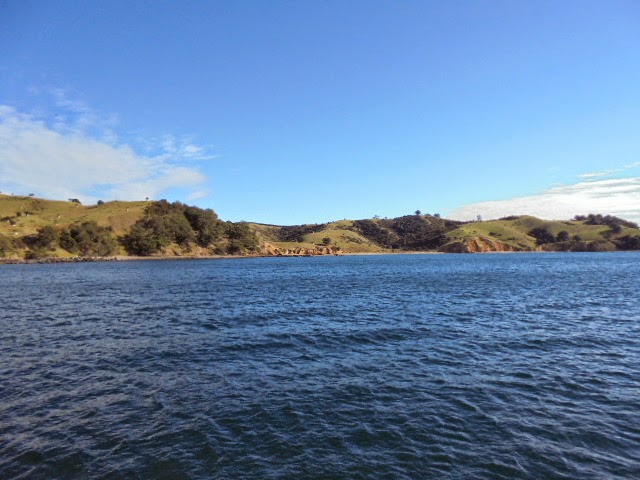
After a quiet night, that is what we encountered by 0900 the following morning. By 1000 it was getting annoying, so we decided to head down to Hook Bay to try for a bit of fishing. So...up with the anchor and off, right?? Remember that cable I had never run foul of? There it was - over the anchor chain and across the prong of the anchor. Fortunately there was no wind and in the calm conditions we were able to get free with a minimum of blood, sweat and tears, but a reasonable amount of cussing. The wind was blowing a cool SE 10 to 15 knots, so we were well sheltered going down tn N side of the island, but round the corner into the Firth of Thames it was a little more willing, as the Firth provides plenty of reach for waves to build. We tried our drift fishing tactic across Hooks Bay, but there was a fair amount of slop coming from the Firth, so it was not particularly comfortable. While the weather can be reasonable around Queens Birthday, the fishing is usually lousy, and we were not to be disappointed in that fact on that day. We got quite a mixed bag,,,,snapper, red cod, a gurnard, several mackerel and even a large squid, but only 2 snapper over the new size limit of 30cm (although we caught about 10 that would have been legal 3 months ago!) Anyway I took the time to take a few pics of the bay and Firth with my new camera, so those who have been waiting for more pix of NZ scenery.....here you go. BTW the weather is ALWAYS like this over here (yeah, right!)

The next 4 are Hook Bay


Looking across the Firth to Coromandel

The Moehau ranges at the tip of Coromandel Peninsular

And here's the squid


After several hours of disappointment, we took some steak out of the freezer to thaw while we travelled back up the coat to Pie Melon Bay to anchor for the night. Although the weekend had seemed get off to a slow start, probably due to the weather forecast, it was becoming obvious that there were many boats out enjoying a better-than- expected weekend, as most of the bays on the N side of Waiheke were well populated with boats.


The next day was spent out at D'Urville Rocks, a rock outcrop rising above water from a depth of 100ft, about 3NM offshore N of Waiheke. The weather improved as the day went on, but the fishing didn't, despite our using the squid for bait - something that we were roundly criticised for later as it would have made marvellous eating! We caught a lot of fish and many would have been legal under the old 270mm regime but, alas, only 2 were under the new one. In the end we figured we had at least caught the value of the bait in snapper fillets (at $37 per kilo we only had to catch enough to give us 900gm of skinned and boned fillets) and kept ourselves occupied for 2 days.

We spent our last night at a crowded Oneroa and the next day had a pleasant trip back to the marina on which Charlie and I spent another night aboard LK before going up to Kerikeri to collect the Admiral. Some interesting statistics came out of this weekend: Water usage was 14 litres per person per day instead of the usual 25; the overnight battery capacity remained higher each morning and we used the genset about an hour less each day.

Well I said I would try to do better - Till next time

Sunday, 15 June 2014

Rather belated Easter posting

On the 25th June each year New Zealand and Australia commemorate those who fought in  the various wars in which our two countries have participated. The public holiday is known as ANZAC (Australia New Zealand Army Corps) day and this year it fell on a Friday. Coincidentally Easter was quite late this year, falling the weekend before ANZAC and so, the canny people who caught on to this realised that by taking 3 days of annual leave in between, they would get 10 days uninterrupted holiday at a time when the weather is still relatively clement. A lot of kiwis figured this out and the wheels of commerce ground rather slowly over that week.

Being retired, it mattered to us not a jot! However we had offered to take out Aunty Lyn (also retired) and Lois, who works still but was one of the canny ones. As a result we were able to get away from the marina on the Thursday before Easter for 10 days of cruising. The forecast was not crash hot for the Easter weekend, but was due to improve early in the following week and we hoped to be able to cross the Firth of Thames to Coromandel, one of our favourite destinations.

Over 2 days we worked our way down the "inside" of Waiheke Island  finished up in Man O War Bay, which has been mentioned in previous postings.

For several days the weather was too bad to venture too far -we did once try to get round to our beloved Hook Bay to go fishing, but the 3 metre swells in the Firth of Thames soon put paid to that idea! Instead we stayed put in MOW Bay and decided to feast on the bounty of shellfish that is available thanks to the proliferation of mussel farms in the area. For the uninitiated or just unaware readers, NZ has an indigenous mussel unique to our waters (perna canalicula) which grows to 240mm (10") and is very high in Omega 3, so is quite sought after. Once upon a time it was relatively hard to find and a great, yet expensive, delicacy - unless you knew someone who knew someone. However in the 70's they began farming them and now they are prolific throughout the Hauraki Gulf - particularly in the Firth (of Thames). At low tide the piles on the wharf at MOW are covered with them and it was easy to get enough for a feed in a very short space of time.Why am I telling you this? Surely such information will have the resource plundered in no time. Nah! They grow so fast that it would be hard to imagine them being stripped, and since they sometimes only cost $2.99/kg at the supermarket live, fresh and washed clean, most Kiwis can't be bothered collecting them. Our gain - in 10 minutes we had a bucketful (you're allowed 40 per person per day). There are several popular ways to eat this delicacy - raw (yuk), steamed open (yum), marinated in vinegar and onions (yummier) and in fritters (yummiest). You can also deep fry them in batter, which is also pretty good. We had decided that fritters were the way to go for these with the surplus to be marinated in white vinegar, onions and lemon juice for later consumption. Now I have eaten a fair few mussel fritters in my time and have come up with a recipe that suits me and can make a few mussels go a long way, without losing the flavour.

Take about 20 mussels, about 100mm (4") long. This is the typical size of farmed mussels, as overseas  buyers are suspicious that larger ones will be tougher - which is nonsense because they are exquisitely tender right up to their full size. Take the 6 biggest and open them raw (this is the secret of a good fritter) - it is not easy but it doesn't matter if you mess them up as you chop them up anyway. Keep all the juice that comes out with the meat. Put the rest of the mussels in a pot with 1 cup of water and steam them open. De-shell them (get rid of the beard and any crabs that are inhabiting them) and keep some of the liquid. This is the mussel part of the fritter, the  rest is:

1 100mm (4") cooked cold potato (do it earlier in the microwave, or boil it), diced fine
1 med onion, diced fine
1 tomato, diced fine
2 rashers bacon (4 of streaky), chopped fine
2 eggs
1 cup beer (drink the rest while cooking)
1 cup self raising flour
1 pinch of curry powder (the amount will depend on how strong the curry is - if it tastes of curry, you have used too much)
a touch of black pepper

Chop the raw and cooked mussel meat fine and add to a bowl. Add the liquid from the raw mussels. Add the potato, onions, bacon and eggs and stir to separate. Add the flour, curry, pepper and beer while stirring and add some of the steamed mussel liquid to thin the mixture down to a thick batter. Carefully fold in the tomatoes and leave to stand for a couple of hours. Heat a frypan with a little oil and spoon the mixture into it in about 100mm fritters, which should stand about 10.mm high. Fry until golden brown one side (usually 3-4 minutes) then flip and fry the other side, Eat asap with whatever condiment you feel like - tomato sauce (ketchup) is my choice, but that's me

If you can't get NZ green lipped mussel, you could probably use the little black ones found  in the rest of the world, but you may need twice the number.

The Tuesday after Easter Monday, the wind dropped and the seas came down and the forecast was for it to improve further over the next few days.So across the Firth we headed and into Coromandel Harbour. Now Coro is an interesting place - well sheltered, but very shallow at its head, including the approaches to the wharf and the river up to the township. In fact at low tide Coromandels commercial wharf and the river up to town are dry, so to go to the township requires anchoring out a ways and going the 2km or so up the river by dinghy - and even then it is wise to do this on a rising tide and to leave the town as the tide turns to ensure you are still afloat by the time you get back to your boat. We needed water, so we went alongside the wharf on the rising tide with only about 5ft of depth, then anchored out at the sensible point and dinghied up the river. Despite the constraints, it is a super little dinghy ride and the township is cute and deserves the effort. We picked up a few provisions and had the mandatory meal from the fish and chip shop eaten at the reserve across the road, before heading back down river to LK. While there was still plenty of water, we did stray out of the channel at one point and removed a modicum of paint from the outboard's propellor which demonstrated how rocky the bottom is and therefore why it is not a good idea to leave returning to your boat too late.

We departed Coromandel and headed round to Te Kouma Harbour, just round the point from Coro's entrance. This is a very sheltered Harbour, considered the Jewel of the Coromandel. It is deep and fiord-like and its entrance is protected by a large island so it is sheltered from almost any wind. We anchored up amongst about 25 boats and prepared and cooked the mussels collected yesterday, in accordance with the above recipe.
THe next day we tried fishing in several spots on the Coromandel side of the Firth, but to little avail - but the scenery was spectacular, and it was a super day.


The weather forecast was sounding a bit dodgy, so we decided to head back across while it was still calm (as it turned out the next few days were superb - so we could have stayed!!!). Anyway, in the absence of fish we figured we may as well go and get some more mussels! So a night at Chamberlins Bay, Ponui, then 2 more at MOW for more mussels before heading  towards home and our final night at good old Oneroa.
Sorry for the late posting - I shall try to do better

BTW I now have  a new camera so better pix (I hope)

Saturday, 22 March 2014

More Kindred Spirit

Richand, KS's new owner from Wellington, sent me a video of her underway in the Marlborough sounds after her repaint. She looked so nice I thought I would post it and also use the opportunity to put my first video on the Blog.

BTW the first attempt using Windows Explorer didn't work (like the pix downloads wouldn't before) so I'm using Google Chrome this time

Here goes...
Yahoo - seems to have worked

Well sort of anyway - looks like it may have been filmed on an iPad, and I can't figure how to rotate it round (the original comes up right way up on my computer). So you'll just have to watch it lying down (or turn your screen on its side)